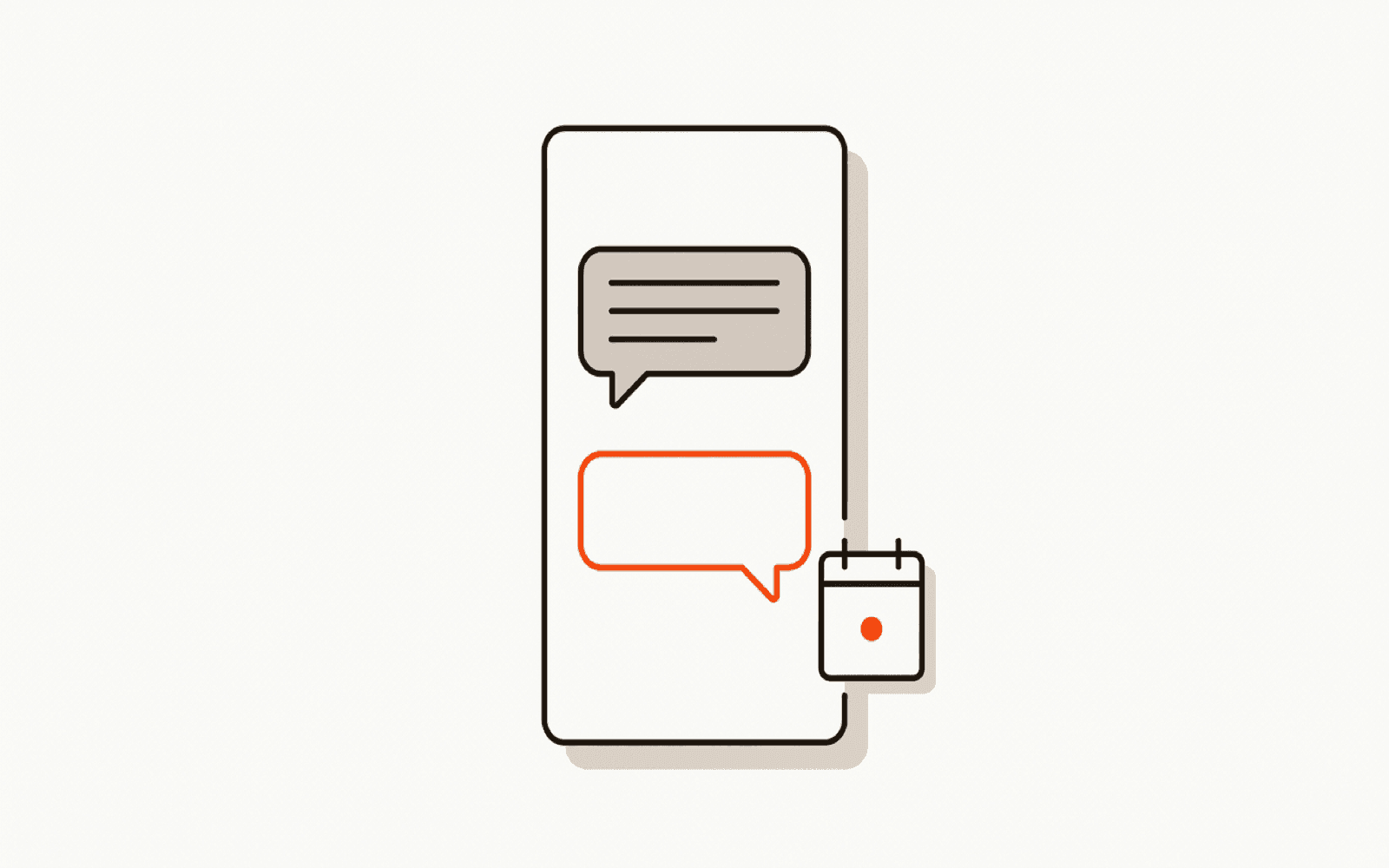








Three levels of "answering", and only one is risky
Most owners picture one thing and get sold another. There are three separate setups.
Level 1 — Draft only. AI writes a reply. It sits in your drafts. You read it, edit it, send it. Nobody outside your business sees AI output unreviewed. This is the lowest-risk option and it still saves real time.
Level 2 — Answer with approval. AI writes and proposes the reply inside a helpdesk. A person clicks approve. Faster than Level 1, still human-gated.
Level 3 — Answer autonomously. AI replies directly to the customer with no human in between. This is what "AI answers my inquiries" usually means in advertising, and it is the only one that carries real liability.
Start at Level 1. Move up when you have measured it. Most US small businesses do not need Level 3 to get most of the benefit.
What the published numbers actually say
Klarna's February 2024 press release is the most-quoted case study. Every figure below comes from that release (klarna.com):
- 2.3 million conversations in the first month.
- Two-thirds of Klarna's customer service chats.
- Work equivalent to 700 full-time agents.
- Resolution in under 2 minutes, against 11 minutes previously.
- A 25% drop in repeat inquiries.
- 23 markets, 24/7, in more than 35 languages.
- An estimated $40 million profit improvement for 2024.
That is the half everyone quotes. The other half matters more. In May 2025 Klarna reversed course and started rehiring human agents (customerexperiencedive.com). CEO Sebastian Siemiatkowski said that when cost dominates the decision, "what you end up having is lower quality" (entrepreneur.com).
Klarna did not switch the AI off. It kept it for routine work and put people back on the complex and emotional cases. That is the actual lesson, and it is the shape most small businesses should copy.
Vendor benchmarks should be read the same way. Fin, the AI agent from Intercom, publishes an average resolution rate of 76% across 12,000+ customers and around 2 million resolutions a week (fin.ai). That is a vendor's own figure, self-reported and not independently audited. Treat it as a best case for a business with a large, clean, well-maintained help center.
The honest framing: the ceiling is high, the average business does not hit the ceiling, and the gap is almost always the quality of your written answers.
Which inquiries to hand over, and which to keep
| Inquiry type | Give to AI? | Why |
|---|---|---|
| Opening hours, location, parking | Yes | Fixed facts, low harm if repeated |
| "Where is my order?" with a tracking lookup | Yes | Deterministic answer from a system |
| Return and refund policy questions | Yes, if your policy is written down | AI quotes the policy, does not invent it |
| Standard pricing for standard products | Yes, with prices pulled from one source | Never let it calculate a custom price |
| Appointment booking and rescheduling | Yes | Structured task with a clear success test |
| Custom quotes, discounts, payment plans | No | Money terms bind you |
| Complaints, cancellations, anything angry | No | Route straight to a person |
| Anything medical, legal, financial or safety-related | No | Regulated advice, high harm |
| Warranty and liability questions | No | The answer creates an obligation |
The dividing line is not difficulty. It is consequence. If a wrong answer costs you money or a relationship, keep a human on it.
You are on the hook for what it says
This is the part vendors skip.
In Moffatt v. Air Canada, 2024 BCCRT 149, a tribunal held Air Canada liable for a negligent misrepresentation made by the chatbot on its own website. Air Canada argued the chatbot was a separate entity responsible for its own answers. The tribunal rejected that and ordered C$812.02 in total, made up of C$650.88 in fare difference, C$36.14 interest and C$125 in fees (cbc.ca, americanbar.org).
The award is small. The principle is not. Your chatbot's statements are your statements.
In the United States, the same exposure runs through Section 5 of the FTC Act, which prohibits unfair or deceptive acts or practices. In September 2024 the FTC announced Operation AI Comply. It brought five enforcement actions over allegedly deceptive AI-related conduct, including a proposed $193,000 settlement with DoNotPay over claims about its "AI lawyer" (ftc.gov).
Practical consequence: whatever your bot promises about price, delivery, warranty or eligibility, assume you will be held to it.
How to set it up in five steps
- Write the source of truth first. One document. Every common question with the exact answer you would give. If you cannot write it, AI cannot answer it. This is most of the work, and it is the step people skip.
- Point the AI at that document only. Not the open internet, not its training data. Configure it to answer from your file and to say "let me get a colleague" when the file has no answer.
- Build the escalation path before you go live. Decide what triggers a handover to a person: an explicit request, a refund word, a complaint word, two failed attempts. Test that the handover actually works.
- Run it silently for two weeks. Let it draft. Read every draft. Count how many you would have sent unedited. That percentage is your real resolution rate, not the vendor's.
- Turn it on for one narrow category. Order status, or hours, or bookings. One. Expand only when the numbers hold.
What most people get wrong about this
Deflection is not resolution. A bot that ends the chat has deflected. A bot that answered the question has resolved. Vendors sometimes report the first and call it the second. Measure by "did the customer come back?", not "did the chat close?"
The knowledge base is the product. The model is nearly a commodity. Your written answers are the thing that makes the output good or bad. Businesses that get poor results almost always have a thin or out-of-date help center.
Escalation is a feature, not a failure. A bot that hands off cleanly at the right moment wins. It beats a higher answer rate that argues with an angry customer.
"24/7 coverage" is the real win, not headcount. For most small US businesses the benefit is answering at 9pm on a Sunday, not firing anyone.
What it costs
Pricing in this market has moved to outcomes. Fin advertises outcome-based pricing: you pay when it resolves, not a flat seat fee (fin.ai). The site does not publish a per-resolution figure on its front page, so you have to ask.
If you build it yourself with an automation tool, the cost is per action. Zapier's Professional plan starts at $19.99/month billed annually for 750 tasks, or $29.99/month billed monthly (zapier.com/pricing). Make's Core plan starts at $9/month for 10,000 credits (make.com/en/pricing).
Add your own time. Two weeks of silent running and a written knowledge base is the real cost, and it is not optional.
Where these figures come from
- Klarna press release, 27 February 2024 — 2.3m conversations, two-thirds of chats, 700 agent equivalent, under 2 mins vs 11 mins, 25% fewer repeat inquiries, 23 markets, 35+ languages, $40m estimated 2024 profit improvement. https://www.klarna.com/international/press/klarna-ai-assistant-handles-two-thirds-of-customer-service-chats-in-its-first-month/
- OpenAI customer story on Klarna, with the same figures. https://openai.com/index/klarna/
- Entrepreneur — "Klarna Is Hiring Customer Service Agents After AI Couldn't Cut It on Calls" (May 2025), the reversal and the CEO's "lower quality" quote. https://www.entrepreneur.com/business-news/klarna-ceo-reverses-course-by-hiring-more-humans-not-ai/491396
- CX Dive — "Klarna changes its AI tune and again recruits humans for customer service" (May 2025). https://www.customerexperiencedive.com/news/klarna-reinvests-human-talent-customer-service-AI-chatbot/747586/
- Fin (Intercom) — published average 76% resolution rate across 12,000+ customers; vendor self-reported. https://fin.ai/
- Moffatt v. Air Canada, 2024 BCCRT 149 — company liable for chatbot misrepresentation, C$812.02 total. CBC report: https://www.cbc.ca/news/canada/british-columbia/air-canada-chatbot-lawsuit-1.7116416
- American Bar Association — "BC Tribunal Confirms Companies Remain Liable for Information Provided by AI Chatbot" (February 2024). https://www.americanbar.org/groups/business_law/resources/business-law-today/2024-february/bc-tribunal-confirms-companies-remain-liable-information-provided-ai-chatbot/
- FTC — "FTC Announces Crackdown on Deceptive AI Claims and Schemes" (Operation AI Comply, 25 September 2024). https://www.ftc.gov/news-events/news/press-releases/2024/09/ftc-announces-crackdown-deceptive-ai-claims-schemes
- Zapier pricing page (checked September 2026). https://zapier.com/pricing
- Make pricing page (checked September 2026). https://www.make.com/en/pricing
People also ask
- Do I have to tell customers when a reply is written by AI?
- How do I stop AI making things up in my documents?
- Zapier or Make: which should a non-technical person use?
- What should an AI never be allowed to tell a customer?